
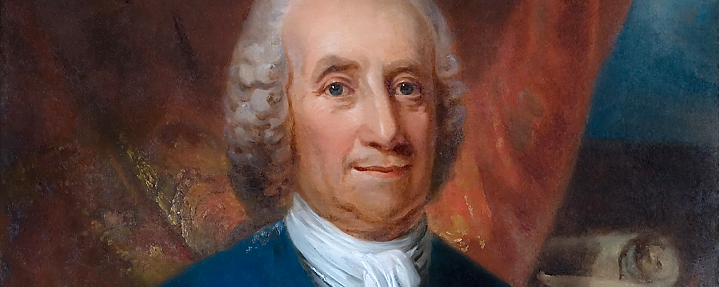
Emanuel Swedenborg claimed that he was commissioned by the Lord to reveal the hidden, spiritual meaning of the Old and New Testaments. He also claimed that the Lord had opened his eyes so that he could vist angels in heaven, devils in hell, so that he could describe their lives there. These are highly unusual claims, so how can we possibly believe such claims are true?
Was Swedenborg just full of fancies (fanciful people make up stories and tell tall tales)? But that is just the thing about Swedenborg, he was not a man given to telling tall tales, rather he was, by all accounts, a solid and trustable man.
Unusual things happen every day, and if we are to trust them, we must ascertain if the person telling the account is a trustworthy person, and if his account can be corroborated. First, we will consider if Swedenborg was trustworthy, and to do that, we will take a brief look at some aspects of his life. After that we will consider if his account can be corroborated.
Biographical sketch
Swedenborg studied at the University of Upsala from 1699 graduating June 1st, 1709. He spent the next 7 years studying abroad and publishing books. All the hard work paid off, and in 1716 Christopher Polhem (the famous Swedish engineer) recommended Swedenborg to the king who granted Swedenborg a position on the board of mines (Sigsted, 1952, p. 41). Then in 1724 he was finally granted a salary as well (Sigsted, 1952, p. 93). For thirty years he worked on the board of mines in Sweden. Here he was one of five men who oversaw all the mining operations in Sweden. This was a very important and trusted position, as mining provided an important revenue stream for the country.
When he left this position on the board of mines, it was not because he had fallen out of favor with his superiors. Indeed, it was widely expected that he was to be elevated to councilor of the bord of mines, when Councilor Bergenstjerna retired, because he was so trusted. However, instead, Swedenborg wrote to the king and asked that he be allowed to retire from the job with half a salary as his pension, because he was going to embark on further journeys and more publishing. The king granted his request, but in the minutes from the College of Mines we read:
All the members of the Royal College regretted losing so worthy a colleague, and they asked the Assessor to kindly continue attending the sessions of the College, until all those cases should be adjudicated that had been commenced during his attendance at the College, to which the Assessor kindly assented. (Tafel, 1875, p. 446)
All in all, Swedenborg had spent 30 years in this trusted position, and he left of his own volition, with the good will of all he worked with, and their continued desire to work with him further. This is the same story we hear from so many others who knew him.
Evidence of Spiritual Abilities
Now we will consider if Swedenborg’s unusual claims can be corroborated by other people. Swedenborg's account of his spiritual perception was, in fact, corroborated by several eyewitnesses; the first documented incident occured when he was in Gothenburg and became aware of the details of a fire raging in Stockholm 600 miles away. There is no way that he could have known about this by any natural means.
At four o’clock on July 19th, Swedenborg and fifteen others were gathered for a dinner party at William Castel’s house on Canal Street in Gothenburg. At about six o’clock Swedenborg left the party and returned pale and greatly agitated. When questioned he said that a fire was spreading fast in South Stockholm. At about eight o’clock he was relieved to report that the fire had been put out. The same evening the story was told to the governor. And the next day Swedenborg was called to the Governors office where he gave a full report. On Monday a messenger arrived from Stockholm who had been dispatched while the fire was still raging. The letters he carried corroborated Swedenborg’s account of the fire in detail (Sigsted, 1952, pp. 269-270).
Another well documented incident occured in the spring of 1761 Mme. de Marteville approached Swedenborg asking if he might be able to contact her recently deceased husband in the spirit world. Mme. de Marteville had recently been approached by a silversmith who demanded payment for a silver service her husband had bought. She was very surprised at this as her husband used to pay his bills in a very timely manner. Swedenborg agreed to see what he could do. He then said that he met M. de Marteville, who said that he would promptly go look for it. According to Mm. de Marteville, she was visited by her husband in a dream eight days after her visit with Swedenborg. M. de Marteville told her in detail where the receipt lay in an English bureau. She arose straight way and found it, then went back to sleep. The next morning, Swedenborg visited her, and before she could tell him of the dream, he mentioned that he had, indeed, met with her husband in the Spiritual World again that night, but that he had not had any discussion with him this time, because M. de Marteville had said he needed to go tell his wife something of importance. (Sigsted, 1952, pp. 277-8).
Finally, for now, in late October 1761 the Queen of Sweden Louisa Ulrika asked Swedenborg to contact her deceased brother. On November 15th Swedenborg returned and asked to see the Queen alone. The Queen brought Senator von Schwerin and Swedenborg to another room. The Senator was posted at the door while she and Swedenborg went to the far end of the room. Swedenborg said something to her in private, at which she took three steps backwards and exclaimed “That is something that no one else could have told, except my brother.” Count Tessin wrote: “I nevertheless feel all the more safe in putting it down, as Her majesty’s obvious consternation is unanimously vouched for by those who were in the room, and amongst others by Count Carl Scheffer.” (Sigsted, 1952)
These three are the best-known accounts corroborating Swedenborg’s abilities to see into the spiritual world, and there are more. If, after this short article, you should wish to read more about Emanuel Swedenborg, the best biography is The Swedenborg Epic by Cyriel Odhner Sigsted. At 444 pages it is also the longest. A Scientist Explores Spirit by George F. Dole and Robert H. Kirven is shorter, just 74 pages and therefore a much quicker read.
And if you are interested in exploring the wonders of the Spiritual World that Swedenborg saw and discussed at length in the books he published, drop me a note and I will be happy to send you a copy of Heaven and Hell, free of charge. I can be reached at: ohauptmann@gmail.com
Bibliography
Sigsted, C. O. (1952). Swedenborg Epic. New York: Record Press.
Tafel, R. L. (1875). Documents Concerning Swedenborg. London: Swedenborg Society.